Johnson County has a genuine, measured radon problem. These are the numbers and where each one comes from.
The county and state figures
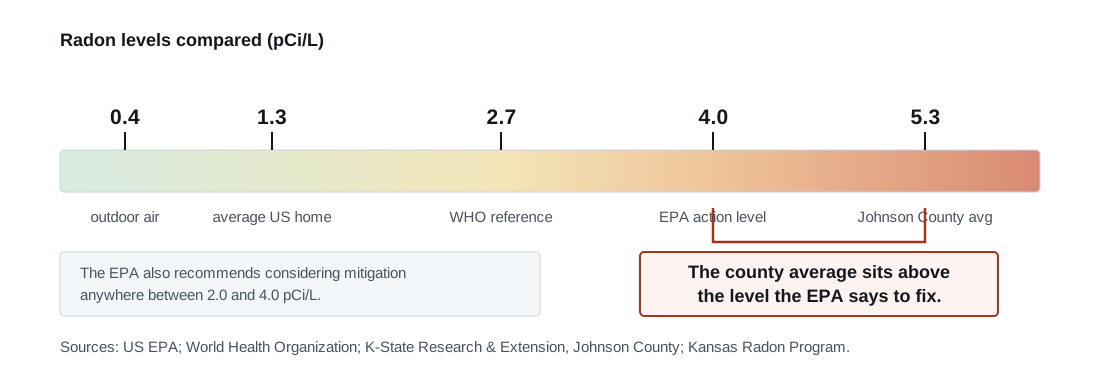
| Measure | Value |
|---|---|
| Johnson County average | 5.3 pCi/L |
| Kansas statewide average | 4.9 pCi/L |
| EPA action level | 4.0 pCi/L |
| Kansas measurements at or above 4.0 | 41% of over 46,000 |
| EPA radon zone | Zone 1 (highest risk) |
| Average US indoor level | 1.3 pCi/L |
| Average outdoor air | 0.4 pCi/L |
The headline is that the county average is above the level at which the EPA tells you to fix your house. Johnson County is not a place where elevated radon is an unlucky outlier. It is the central expectation.
Why Kansas has unusually reliable data
Most states rely on voluntary reporting. Kansas does not. Statute K.S.A. 48-16a10 requires every KDHE-certified radon contractor and laboratory to submit measurement data to the Kansas Radon Program quarterly.
That mandate is why the state can cite more than 46,000 measurements rather than a sample. When you read that 41% of Kansas tests came back at or above the action level, that figure rests on a legally compelled dataset, not a survey.
Where the radon comes from
Eastern Kansas sits on fractured limestone and shale. Uranium occurs naturally in that rock; as it decays, one of the products is radon gas. The gas migrates through soil and rock fractures until it reaches the surface, or the underside of a building.
Lenexa offers the clearest illustration in the county: the National Archives stores federal records in excavated limestone caverns beneath the city. That is the rock, visible at scale.
What a county average does and does not tell you
It tells you to test. In a Zone 1 county averaging 5.3, testing is the default action for every home.
It does not predict your house. Two neighboring homes routinely differ by a factor of three or more, because the variables are local: your foundation type, whether your sump pit is sealed, how tight your building envelope is, and how hard the stack effect pulls on the soil beneath your slab. Radon is a property of the house-plus-ground system, not of the ZIP code.
This is the single most common misconception we correct. A neighbor’s low reading is not evidence about your home.
Seasonal variation
Readings in the same house move through the year. Winter is typically highest: the house is closed up and the temperature difference drives a stronger stack effect, pulling more soil gas through the foundation. A summer short-term test can read comfortably under 4.0 in a house that exceeds it in January.
For a decision about spending money, a long-term test of 90 days or more is the number worth trusting.
Sources
- Johnson County average and test kit availability: K-State Research & Extension, Johnson County
- Statewide average, measurement count and percentage above action level: Kansas Radon Program
- Certification law and quarterly reporting statute: Kansas Department of Health & Environment
- Action level, zone designations, US indoor and outdoor averages: US EPA
Want a straight answer about your house? We will tell you whether an $8 to $15 test kit is enough before we quote anything.
Call (913) 421-2530Common questions
What is EPA Radon Zone 1?
Zone 1 is the EPA's highest-risk category, predicting an average indoor radon screening level above 4.0 pCi/L. All of Johnson County is designated Zone 1. The designation is a planning tool for building codes and awareness, not a prediction for any individual house.
Where can I get a cheap radon test in Johnson County?
The K-State Research and Extension office at 11811 S. Sunset Drive, Suite 1500 in Olathe sells DIY radon test kits for roughly 8 to 15 dollars, with lab analysis included in the price. Call 913-715-7000 to confirm current pricing and availability.